

POPULATION OF BLACK IN USA BY COUNTY.
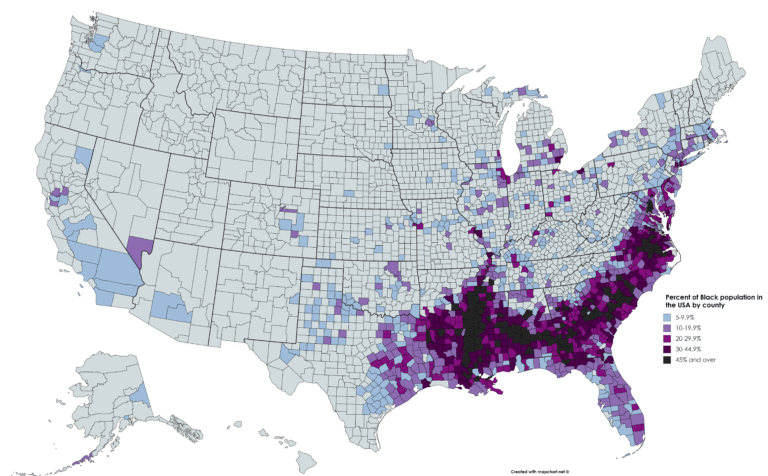
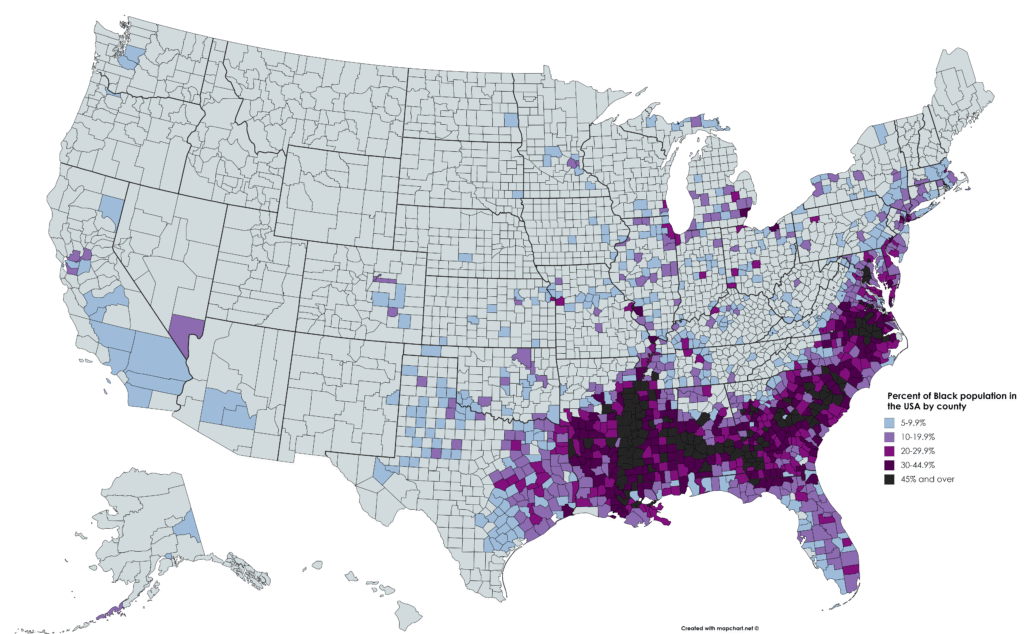
The map displays the percentage of Black population by county across the United States, illustrating highly uneven distribution patterns. Counties in the Southeast—especially those in Mississippi, Alabama, Georgia, South Carolina, and Louisiana—stand out with large proportions of Black residents, many having majorities exceeding 45%.
This region, known as the “Black Belt,” historically attracted significant Black populations due to plantation agriculture, slavery, and later sharecropping, with limited out-migration during the Great Migration era. In contrast, most counties in the Midwest, West, and Northeast display far lower percentages, generally less than 10%, except for scattered city centers and pockets in California, Washington, and some northeastern metropolitan areas.
Black Population in Economically Developed Regions
Some economically developed urban counties, notably large metropolitan areas like Atlanta (Georgia), Houston (Texas), Washington D.C., and parts of California, host substantial Black populations. These cities have historically been magnets for Black Americans seeking greater economic opportunities, political engagement, and social mobility during and after the Great Migration. The prevalence of Black populations in “socialist counties”—those with expanded social benefits, diverse economies, and greater public sector employment—can be traced to job availability, inclusive policies, and established Black communities that provide support for newcomers. Southern cities especially have seen the return of Black populations in recent decades, as improved infrastructure, economic revitalization, and community networks foster higher growth rates for Black entrepreneurs and professionals.
Concentration in the Eastern United States
Most of the majority-Black counties are concentrated on the east bank of the U.S.—stretching from Louisiana and Mississippi through Alabama, Georgia, and the Carolinas—because this area was the epicenter of plantation agriculture during slavery. After emancipation, limited opportunities and social networks meant many Black families remained in this region. Additionally, waves of migration northward in the early 20th century were followed by a recent “New Great Migration,” with Black Americans returning to the South for better economic prospects, supportive communities, and growing urban economies. This historic pattern ensures the Southeast remains the geographic heart of Black America, while economic opportunity and regional policies continue to anchor strong Black populations in certain urban, developed counties across the nation.
Current situation
Nowadays black people are coming at a massive pace to live in USA from African countries. A massive migration is happening at this time where a person can easily get some job and to secure his or her future.
Along with these factors other factors like Zohran Mamdani becoming Mayor of the New York city also shape the population of black living New York Metropolitans area. other factors have also changed the Statistics of current population of black people in much of the USA like more Economic activities happening attracts more people to come and a free all-over right to education also developed and grow black population among USA’s counties.
Moreover, immigration is the only real cause to the unnatural population in USA nowadays.