

North America and Europe
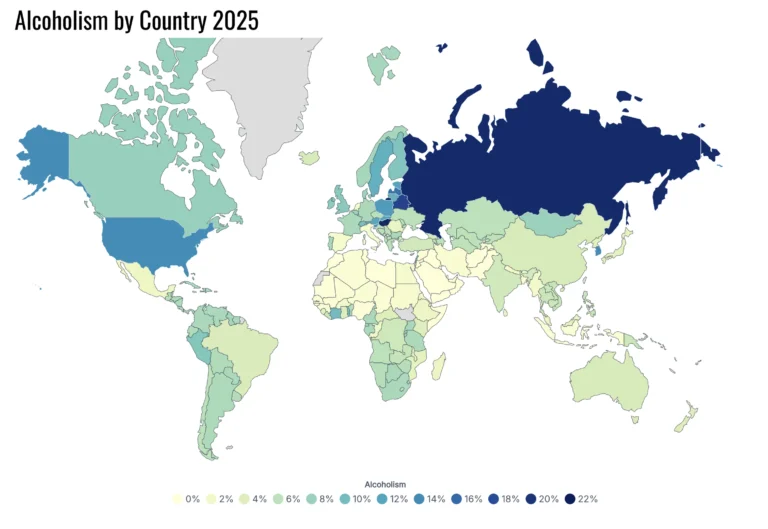
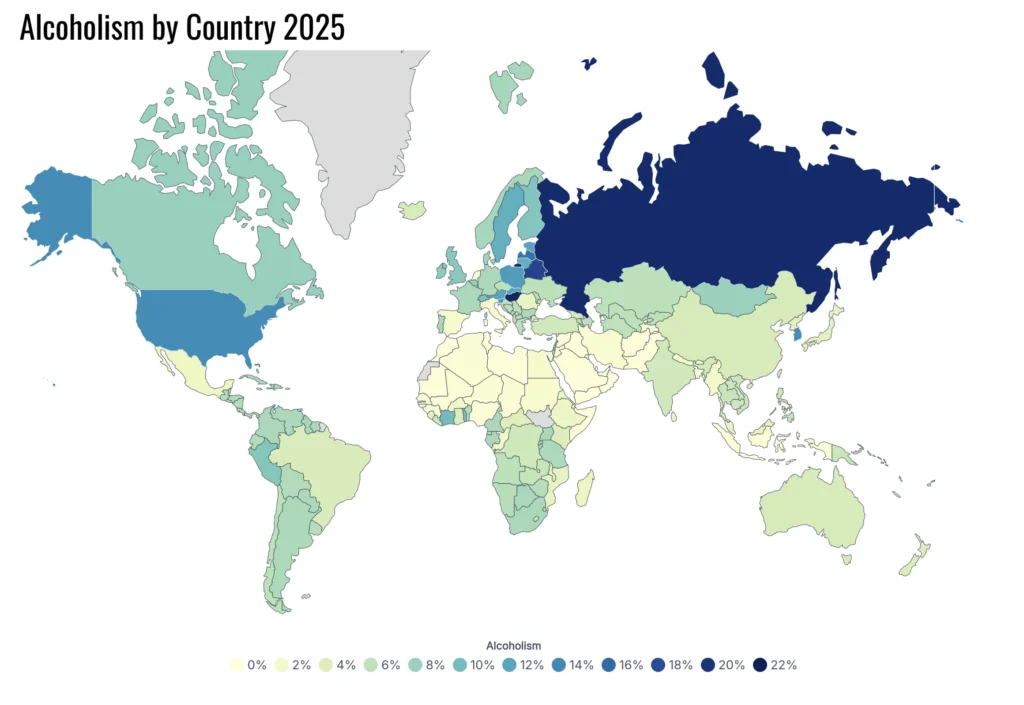
In North America, the map highlights relatively high levels of alcoholism in Canada and the United States, with especially elevated rates in northern areas that experience long, dark winters. Research using international and U.S. data has linked lower temperatures and fewer hours of sunlight with higher overall drinking, more binge drinking, and more alcoholic liver disease, although not all studies agree on the strength of this relationship.
Europe stands out as the world’s heaviest‑drinking region, particularly Eastern Europe and parts of Central and Northern Europe. Historical drinking cultures, cheap and widely available spirits, and, in some places, weaker alcohol control policies contribute to high rates of alcohol use disorders and alcohol‑related disease, far beyond what would be predicted by income levels alone.
Asia and the cold north
Across Asia, the map shows strong contrasts: Russia, Mongolia, and several Central Asian countries are among the darkest‑shaded regions, signalling the highest alcoholism burdens. These countries combine harsh winters with social and economic stress, historical patterns of heavy spirit consumption, and in some cases limited access to mental‑health and addiction services, all of which can encourage high‑risk drinking.
Farther south in Asia, especially in Muslim‑majority states such as Iran, Pakistan, and many Middle Eastern countries, recorded alcoholism levels are markedly lower. Here, religious prohibitions on alcohol, legal restrictions on sale and production, and strong social stigma against drinking reduce both consumption and the proportion of people who meet criteria for alcohol use disorder, although under‑reporting and informal markets mean some harmful drinking still occurs.
Africa, Latin America, and hot climates
Most of Africa appears in lighter shades on your map, indicating lower estimated levels of alcoholism than in Europe or northern Asia. In North Africa and parts of the Sahel, Islamic norms and legal limits keep alcohol use relatively rare, while in many sub‑Saharan countries, low average income and competing health problems mean recorded consumption and alcohol‑use‑disorder rates remain moderate, even though some regions report serious local harms.
Latin America and the Caribbean display a mixed picture, with some Central American and Caribbean nations reaching mid‑range or higher alcoholism rates despite their warm climates. In these countries, cultural acceptance of heavy episodic drinking, urban violence, and limited access to treatment can drive alcohol‑related problems, showing that social factors can outweigh temperature alone.
Why colder regions often drink more
The map’s darker bands across northern Eurasia and parts of North America align with the long‑standing idea that people in colder, darker environments tend to consume more alcohol. One large study that combined meteorological data with alcohol‑consumption and liver‑disease statistics found that as average temperature and sunlight hours decreased, per‑capita alcohol consumption and rates of alcoholic liver disease tended to rise, suggesting that people may use alcohol both to cope with seasonal depression and as a social activity when outdoor options are limited.
However, research is not unanimous: some analyses have found no simple linear link between cold weather and higher drinking, pointing instead to income, inequality, and historical drinking cultures as stronger drivers. The pattern on the map is therefore best understood as climate amplifying existing social and cultural tendencies—cold, dark winters may encourage more indoor socializing and drinking where alcohol is already normalized and easily available.
Why hot and Muslim countries show less alcoholism
In many hot‑climate countries, especially in the Middle East and North Africa, the relatively low prevalence of alcoholism seen on the map is closely tied to religion and law rather than heat. Islamic teaching explicitly forbids alcohol, and many Muslim‑majority states either ban it outright or tightly control production, import, and sale, which reduces the share of people who drink at all and keeps recorded alcohol‑use‑disorder rates among the lowest in the world.
Elsewhere in the tropics—such as parts of sub‑Saharan Africa and South or Southeast Asia—alcohol is legal but average consumption per adult remains moderate, partly because of lower purchasing power, competing basic needs, and, in some areas, strong community norms against heavy drinking. That said, the map also hints at exceptions like parts of Central America and some Pacific or Caribbean islands, where tourism, local drinking traditions, and economic hardship can produce substantial alcoholism despite a warm climate.