



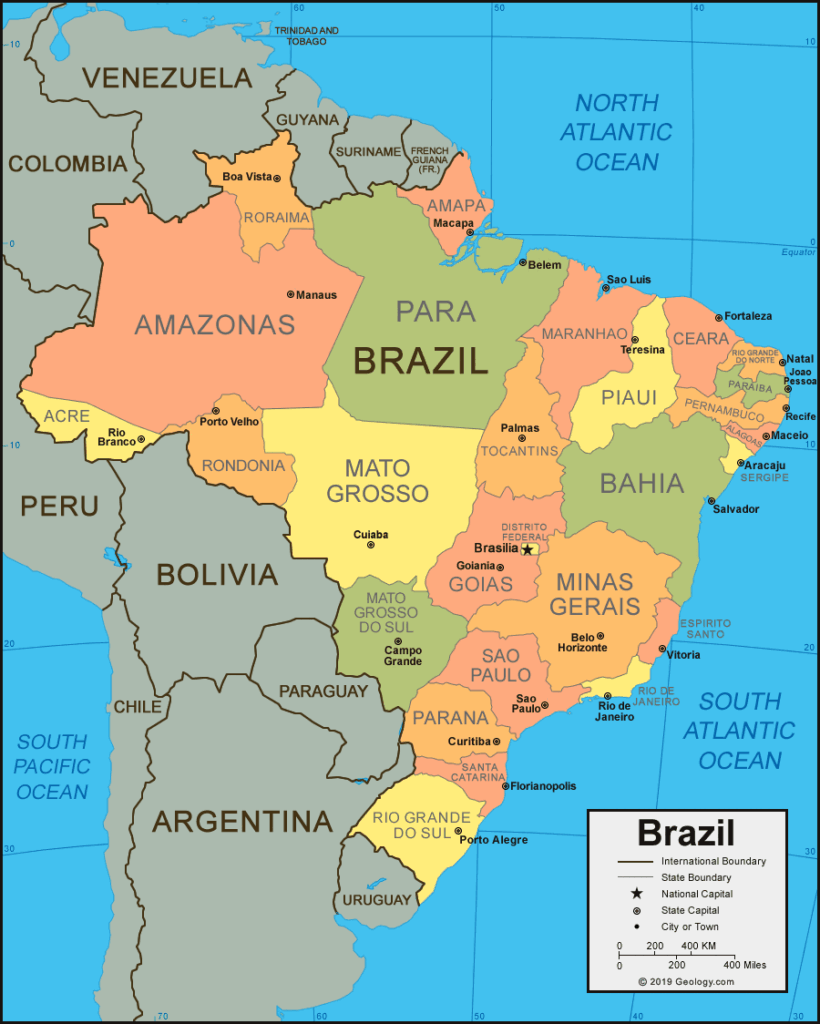
A Comprehensive Geographic and Cultural Overview
Brazil stands as South America’s giant—a nation of continental proportions that commands attention on the world stage. As the fifth-largest country by both area and population, Brazil’s influence extends across economic, cultural, environmental, and geopolitical spheres. For people driven by knowledge, understanding Brazil’s multifaceted identity provides all of us with insights into one of the 21st century’s most significant emerging powers.
Economic Powerhouse: Understanding Brazil’s GDP
Brazil possesses the largest economy in Latin America and ranks among the world’s top ten economies by GDP. The nation’s economic output exceeds $2 trillion, driven by a diverse economic base that includes agriculture, manufacturing, mining, and services. Brazil is a leading global exporter of commodities including soybeans, coffee, sugarcane, beef, iron ore, and crude petroleum.
The country’s economic landscape reflects both tremendous opportunity and persistent challenges. While Brazil has developed sophisticated industries in aerospace, technology, and automotive manufacturing, it also grapples with income inequality, infrastructure needs, and regional economic disparities. The service sector dominates the economy, accounting for approximately two-thirds of GDP, while agriculture and industry contribute the remainder. This economic diversity makes Brazil an excellent case study for students examining development economics and the complexities of emerging markets.
Natural Wonders: Rivers, Mountains, and Jungles
Brazil’s physical geography is nothing short of spectacular. The Amazon River, the world’s largest river by volume, flows over 6,400 kilometers through Brazilian territory, carrying approximately 20% of the world’s river water to the ocean. This mighty waterway, along with its countless tributaries, forms a network that sustains the Amazon Rainforest—Earth’s largest tropical rainforest covering roughly 5.5 million square kilometers.
The Amazon jungle represents one of the planet’s most biodiverse regions, housing an estimated 10% of all species on Earth. Within this green expanse live millions of insect species, thousands of plants, and hundreds of mammals, birds, and reptiles. The rainforest’s role in global climate regulation and oxygen production makes it a critical focus for environmental education.
Beyond the Amazon, Brazil’s terrain includes the Brazilian Highlands, a vast plateau region covering much of the southern and central portions of the country. Mountain ranges like the Serra do Mar and Serra da Antiquaire feature peaks exceeding 2,700 meters. The Pantanal, the world’s largest tropical wetland, sprawls across western Brazil, offering unique ecosystems distinct from the Amazon.
Other significant waterways include the Paraná River, which powers the massive Itaipu Dam—one of the world’s largest hydroelectric facilities—and the São Francisco River, often called Brazil’s “river of national unity” for connecting the country’s interior regions.
Major Cities: Urban Powerhouses
São Paulo, with over 12 million residents in the city proper and 22 million in its metropolitan area, stands as the Southern Hemisphere’s largest city and Brazil’s financial capital. This sprawling metropolis generates approximately 10% of Brazil’s GDP alone and serves as Latin America’s primary business hub.
Rio de Janeiro, famous worldwide for its stunning landscapes, Carnival celebrations, and iconic landmarks like Christ the Redeemer and Sugarloaf Mountain, remains Brazil’s cultural capital and second-largest city. Brasília, the modernist capital designed by Oscar Niemeyer, represents a unique experiment in urban planning with its distinctive aircraft-shaped layout.
Other significant cities include Belo Horizonte, an industrial and mining center; Salvador, the heart of Afro-Brazilian culture; Recife and Fortaleza in the Northeast; and Porto Alegre in the prosperous South. Each city reflects different aspects of Brazil’s regional diversity and development patterns.
Geographic Diversity and Regional Character
Brazil’s immense territory encompasses five distinct regions, each with unique geographic and cultural characteristics. The North region contains the Amazon Rainforest and remains the least populated area. The Northeast, Brazil’s poorest region, features a semi-arid interior called the Sertão and a culturally vibrant coastline influenced heavily by African heritage.
The Southeast serves as Brazil’s economic engine, containing the megacities of São Paulo and Rio de Janeiro. This region produces the majority of the nation’s industrial output and hosts its most developed infrastructure. The South, influenced by European immigration, particularly from Germany and Italy, has a cooler climate and strong agricultural economy. The Center-West region includes the Cerrado savanna and the nation’s capital, Brasília, a planned city constructed in the 1960s to promote interior development.
Sports Obsession: More Than Just Football
Brazil’s passion for sports, particularly football (soccer), borders on religious devotion. The nation has won five FIFA World Cup championships—more than any other country—and has produced legendary players like Pelé, Ronaldo, Ronaldinho, and Neymar. Football permeates Brazilian culture, serving as a source of national pride and social cohesion across class and regional boundaries.
Beyond football, Brazil excels in volleyball, mixed martial arts, motorsports, and beach sports. The country has hosted major international sporting events including the 2014 FIFA World Cup and 2016 Summer Olympics. Sports serve as a vehicle for social mobility and national unity in Brazil, with local clubs commanding fierce loyalty and athletes achieving iconic status.
Military Strength and Strategic Position
Brazil maintains the largest military force in Latin America, with approximately 360,000 active personnel across its Army, Navy, and Air Force. The nation invests significantly in defense capabilities, including developing its own armored vehicles, aircraft, and naval vessels through domestic defense industries.
Brazil’s military doctrine emphasizes territorial defense, regional stability, and participation in United Nations peacekeeping operations. The country has contributed troops to numerous international missions, particularly in Haiti and Lebanon. Brazil’s Amazon Military Command monitors and protects the vast rainforest region, addressing challenges like illegal mining, deforestation, and border security across remote frontier areas.
The nation’s strategic position includes control over crucial South Atlantic sea lanes and extensive maritime resources along its 7,491-kilometer coastline. Brazil’s military modernization efforts reflect its aspirations for greater regional leadership and global influence.
A Melting Pot of Diversity
Brazil’s population exceeds 215 million people, making it the sixth-most populous nation globally. This demographic reflects extraordinary diversity—the result of indigenous peoples, Portuguese colonization, African slavery, and waves of immigration from Europe, Asia, and the Middle East.
The population is predominantly urban, with over 87% of Brazilians living in cities. This urbanization has created both opportunities and challenges, including the growth of favelas (informal settlements) in major cities. Brazil’s demographic profile shows a relatively young population, though it is aging gradually as birth rates decline and life expectancy increases.
Portuguese serves as the official language, unifying this vast nation, while regional dialects, indigenous languages, and immigrant languages add linguistic richness. The Brazilian people’s ethnic diversity creates a society where racial and cultural mixing, known as mestiçagem, has shaped national identity.
Global Influence and the BRICS Alliance
Brazil’s importance on the world stage has grown significantly in recent decades. As a founding member of BRICS—alongside Russia, India, China, and South Africa—Brazil represents emerging economies seeking greater influence in global governance. The BRICS alliance advocates for reforming international financial institutions, increasing South-South cooperation, and providing an alternative voice to Western-dominated global structures.
Brazil plays a leadership role in Latin American affairs, advocating for regional integration through organizations like Mercosur and UNASUR. The nation positions itself as a bridge between developed and developing worlds, championing issues like climate change action, sustainable development, and global poverty reduction.
As a major agricultural exporter, Brazil significantly impacts global food security. Its energy matrix, heavily dependent on renewable hydroelectric power and biofuels like ethanol, offers models for sustainable development. However, tensions persist between economic development and environmental preservation, particularly regarding Amazon deforestation—an issue of global concern.
Conclusion
Brazil’s significance extends far beyond its geographic size. This nation of contrasts—modern cities and remote wilderness, economic dynamism and social challenges, cultural exuberance and environmental responsibilities—represents a microcosm of global developmental issues. For educators, Brazil provides rich material for examining geography, economics, culture, and international relations, preparing students to understand an increasingly interconnected world where emerging powers like Brazil shape our collective future.
