



A Land of Ancient Wisdom and Modern Ambitions
India is not a country that reveals itself easily. Sprawling across 3.3 million square kilometers of South Asian territory, it contains multitudes—literally. With over 1.4 billion people, India recently surpassed China as the world’s most populous nation, a demographic milestone that captures both its vitality and its challenges. This is a civilization where sacred cows wander through traffic-choked streets, where software engineers code algorithms by day and offer prayers at ancient temples by evening, where the call to prayer mingles with Bollywood music and the aroma of street-side chai.
Where Mountains Meet Monsoons
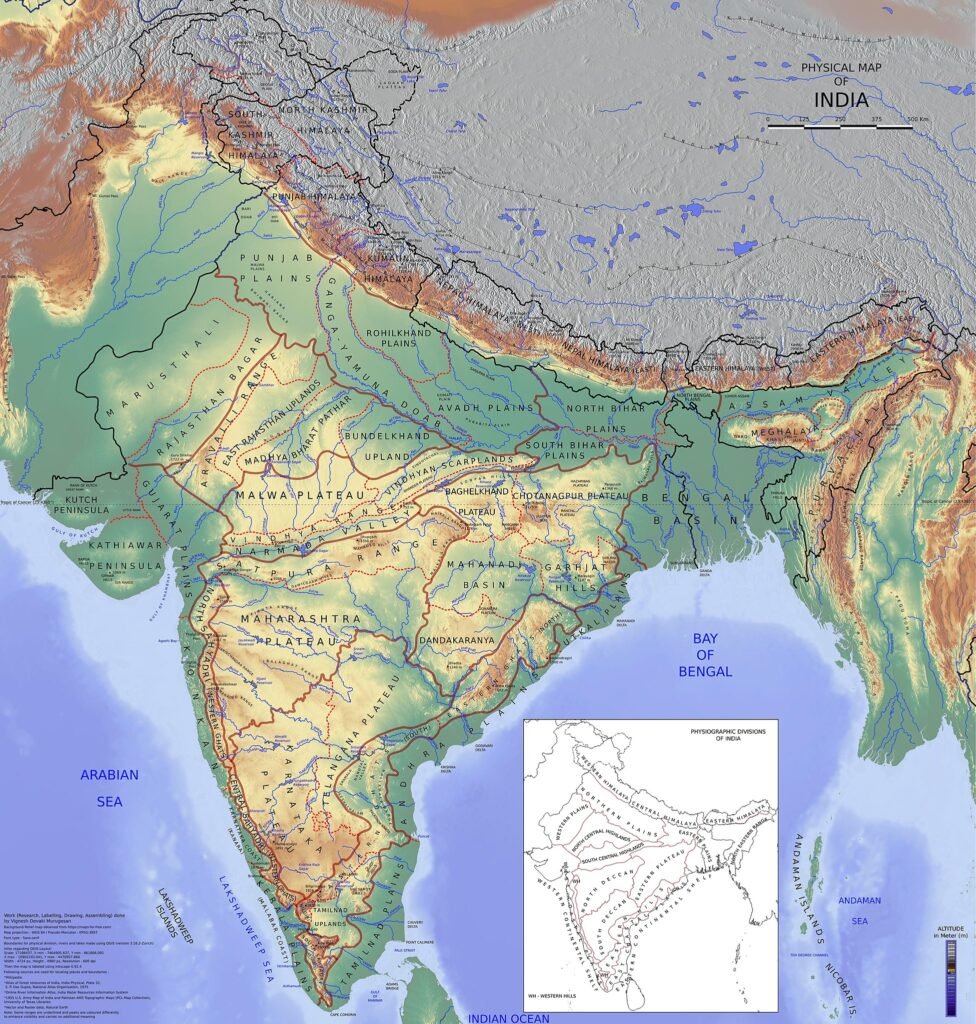
India’s geography reads like a textbook on Earth’s diversity. The Himalayan mountain range guards its northern borders, home to some of the planet’s highest peaks and serving as the source of the Ganges, Yamuna, and Brahmaputra rivers that sustain hundreds of millions. Descend southward and you encounter the fertile Indo-Gangetic plains, the agricultural heartland that has fed civilizations for millennia. Further south, the Deccan Plateau rises, a vast elevated region of volcanic rock. The country is bookended by three bodies of water—the Arabian Sea to the west, the Bay of Bengal to the east, and the Indian Ocean to the south—giving India over 7,500 kilometers of coastline.
The Thar Desert in Rajasthan presents a stark contrast to the lush backwaters of Kerala, while the northeastern states harbor some of Asia’s most biodiverse rainforests. This geographical variety creates distinct climate zones, from the alpine cold of Ladakh to the tropical heat of Tamil Nadu. The monsoon season, arriving each June, is not merely weather but a cultural phenomenon that determines agricultural success, water security, and even the national mood.
A Spiritual Marketplace
Religion in India is not compartmentalized—it saturates daily life. Hinduism claims roughly 80% of the population, making India home to nearly a billion Hindus. Yet India is also the birthplace of Buddhism, Jainism, and Sikhism, and hosts one of the world’s largest Muslim populations at over 200 million. Christians, Zoroastrians, Jews, and adherents of tribal faiths add further layers to this religious tapestry.
Hindu temples, some dating back over a thousand years, dot the landscape. Varanasi, one of the world’s oldest continuously inhabited cities, sees pilgrims bathing in the Ganges to cleanse their karma. The Golden Temple in Amritsar feeds over 100,000 people daily regardless of faith. During Diwali, the festival of lights, the entire nation illuminates. Meanwhile, Eid transforms cities into celebratory hubs, and Christmas sees churches filled across the country. This pluralism, though sometimes tested by communal tensions, remains a defining feature of Indian identity.
The Economy That Refuses to Sleep
India’s economy, currently the world’s fifth-largest by nominal GDP at approximately $3.7 trillion, pulses with contradictions. It is simultaneously home to extreme poverty and extraordinary wealth, to bullock carts and bullet trains. The IT sector has transformed cities like Bangalore and Hyderabad into global technology hubs, with Indian engineers coding for Silicon Valley giants. The country is the world’s largest producer of milk, pulses, and spices, while its pharmaceutical industry supplies affordable generic medicines worldwide.
The services sector dominates, contributing about 55% of GDP, but agriculture still employs nearly half the workforce. Manufacturing is expanding under government initiatives aimed at making India a production powerhouse. Yet infrastructure gaps, bureaucratic hurdles, and income inequality remain persistent challenges. The rupee-earning street vendor and the dollar-earning software developer coexist in an economy growing at 6-7% annually, driven by a young population where the median age is just 28.
When Billions Celebrate Together
Indian culture is an inheritance from dozens of civilizations, invasions, and migrations. Classical dance forms like Bharatanatyam and Kathak tell stories through intricate gestures. Music ranges from the mathematical precision of Carnatic ragas to the soulful strains of Sufi qawwalis. Bollywood, the Mumbai-based film industry, produces over 1,500 movies annually, more than any other country, creating a shared cultural vocabulary across linguistic divides.
The diversity is staggering: India recognizes 22 official languages, though hundreds more are spoken. Each state feels like a different country with distinct cuisines, festivals, and traditions. A Bengali wedding ceremony differs vastly from a Punjabi one. South Indian dosas bear little resemblance to North Indian tandoori dishes. Yet certain threads connect—the importance of family, the concept of jugaad (innovative improvisation), and a philosophical acceptance of life’s complexities.
Cricket Fever and Beyond
If religion is India’s heart, cricket is its pulse. When the national team plays, cities empty. Streets fall silent except for the roar of televisions. Cricket legends like Sachin Tendulkar and Virat Kohli achieve near-divine status. The Indian Premier League, a franchise-based cricket tournament, has become one of the world’s richest sporting events.
Yet India’s sporting ambitions are broadening. Field hockey, once the nation’s pride with eight Olympic gold medals, is experiencing a resurgence. Badminton players like PV Sindhu have claimed Olympic medals. Wrestling, kabaddi, and chess maintain strong followings. However, India’s modest Olympic medal count—relative to its population—remains a source of national introspection, spurring investment in sports infrastructure and athlete development programs.
The Sword and the Olive Branch
India maintains the world’s fourth-largest military, with approximately 1.4 million active personnel. Its defense budget exceeds $70 billion, reflecting security concerns along disputed borders with Pakistan and China. The country possesses nuclear weapons, a sophisticated missile program, and an expanding navy that projects power across the Indian Ocean.
India’s military history is extensive. The wars with Pakistan in 1947, 1965, 1971, and 1999 centered largely on Kashmir. The 1971 conflict resulted in Bangladesh’s creation. Border tensions with China erupted into war in 1962 and continue through periodic standoffs, most recently in Ladakh. India has contributed significantly to UN peacekeeping missions and maintains a stated policy of “strategic autonomy,” refusing to align formally with any power bloc while strengthening partnerships with nations from America to Australia.
Gods, Demons, and Cosmic Battles
Indian mythology offers universes within universes. The Mahabharata, at 100,000 verses, is the world’s longest epic poem, chronicling a dynastic war with profound philosophical digressions. The Ramayana narrates Prince Rama’s quest to rescue his wife Sita from the demon king Ravana. These aren’t merely stories—they’re moral frameworks that continue shaping contemporary ethics.
Hindu mythology presents a pantheon led by the trinity of Brahma the creator, Vishnu the preserver, and Shiva the destroyer. Each deity has multiple avatars and stories. Krishna’s counsel to warrior Arjuna forms the Bhagavad Gita, a philosophical text addressing duty, righteousness, and the nature of reality. These myths infuse art, literature, television, and daily conversation, making ancient wisdom perpetually relevant.
The Unfinished Story
India remains a work in progress, a civilization navigating between tradition and modernity, unity and diversity, poverty and prosperity. Its challenges—from air pollution to gender inequality—are immense. Yet so is its potential, driven by entrepreneurial energy, democratic resilience, and cultural richness accumulated over five thousand years.


