

Global Healthcare Disparity
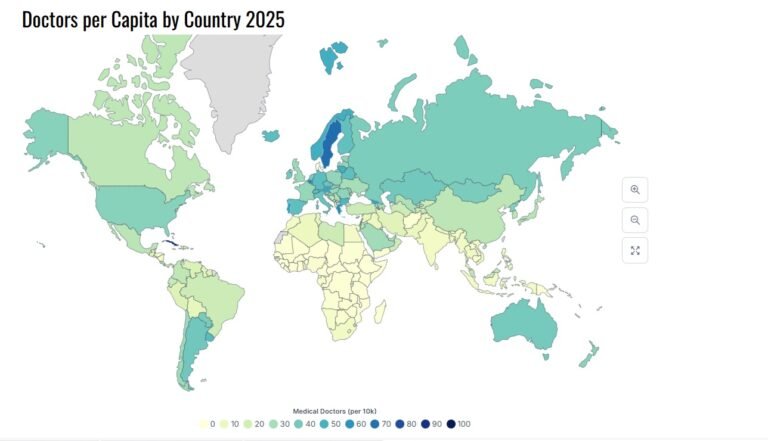
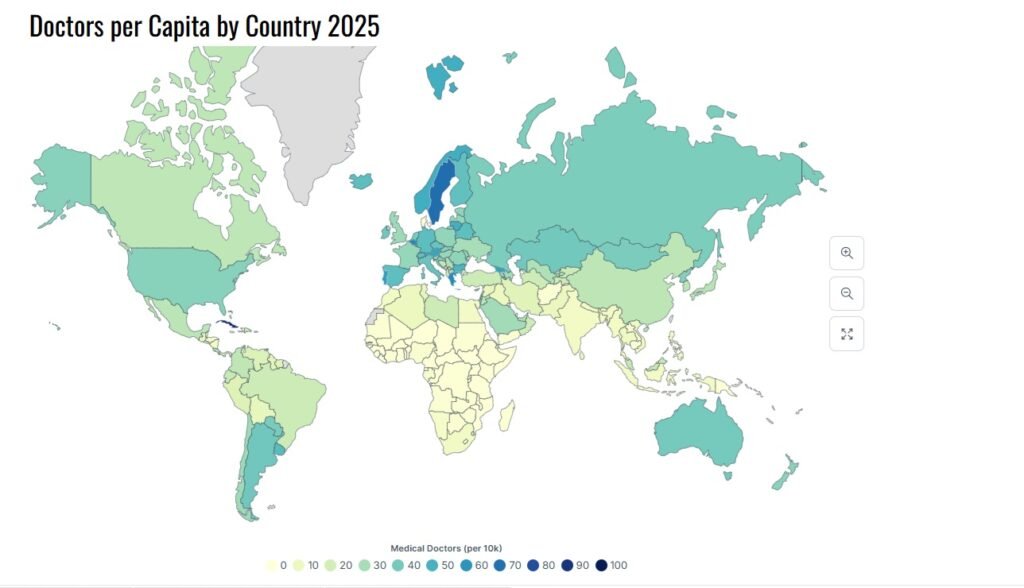
The world map of doctors per capita in 2025 reveals a stark reality about global healthcare access and the critical relationship between educational infrastructure, economic development, and medical workforce capacity. The distribution of physicians across continents tells a compelling story about how nations prioritize healthcare education and invest in producing the medical professionals necessary to serve their populations.
Europe: The Healthcare Education Powerhouse
Europe dominates the global landscape in physician density, with the darkest shades of blue and teal indicating concentrations of 50 to over 100 doctors per 10,000 people across much of the continent. Countries like Germany, Austria, Spain, and the Nordic nations have created robust medical education systems with numerous universities offering comprehensive medical programs. These developed nations have recognized that healthcare access begins with education.
The European model demonstrates how sustained investment in medical colleges and universities creates a self-reinforcing cycle of healthcare excellence. Countries like Germany operate over 40 medical schools, producing thousands of doctors annually while maintaining rigorous standards. The European Union’s emphasis on educational mobility and mutual recognition of medical qualifications has created an ecosystem where medical education flourishes and doctor shortages can be addressed through regional cooperation.
Russia spans the map with relatively strong physician density, reflecting the Soviet-era emphasis on widespread medical education and the continuation of numerous medical institutes across its vast territory. This legacy infrastructure continues to produce doctors at rates that maintain reasonable healthcare access despite economic challenges.
North America: Wealth Meets Selective Medical Education
North America presents an interesting paradox. The United States and Canada, despite being among the world’s wealthiest nations, show moderate to good physician density with 20-40 doctors per 10,000 people, rather than the exceptional numbers seen in parts of Europe. This reflects a different approach to medical education.
American medical schools are notoriously selective, with acceptance rates often below 5 percent at top institutions. The United States operates approximately 155 accredited medical schools, but the number of available positions hasn’t grown proportionally with population increases or healthcare demands. This artificial scarcity, combined with lengthy and expensive training periods, creates bottlenecks in physician supply despite enormous healthcare spending.
Canada faces similar challenges with only 17 medical schools serving a geographically vast nation. Both countries rely heavily on international medical graduates to fill gaps, essentially importing doctors trained in other nations’ educational systems. This approach raises questions about the sustainability and ethics of depending on physician migration rather than expanding domestic medical education capacity.
South America: Regional Variation and Educational Investment
South America displays considerable variation in physician density. Argentina and Uruguay stand out with darker shading, indicating 40-50 doctors per 10,000 people, reflecting their historical emphasis on public universities and accessible medical education. Argentina, in particular, has cultivated a strong tradition of medical education with numerous universities offering free or low-cost medical programs, producing doctors not just for domestic needs but for the entire region.
Cuba, though small, has famously invested heavily in medical education as a national priority, operating approximately 13 medical schools and producing doctors at rates that far exceed its own needs, becoming a major exporter of medical professionals. This demonstrates how even nations with modest economic resources can prioritize healthcare education as a strategic investment.
Brazil shows moderate physician density despite being the continent’s largest economy and population. While the country has expanded its medical schools significantly in recent decades—now operating over 340 institutions—quality concerns and uneven distribution mean that sheer numbers don’t always translate to adequate healthcare access across all regions.
Asia: A Continent of Extremes
Asia presents perhaps the most dramatic contrasts on the map. The darker shades in South Korea, Japan, and parts of China indicate strong physician density achieved through massive investments in medical education infrastructure. South Korea operates approximately 40 medical schools for its population of 51 million, while Japan maintains over 80 medical universities, reflecting cultural values that prioritize education and professional healthcare.
China’s physician density has improved dramatically over recent decades as the government invested heavily in medical education, expanding from roughly 100 medical schools in the 1990s to over 200 today. This expansion reflects recognition that economic development requires parallel investment in healthcare infrastructure and education.
India, despite having numerous medical colleges—over 600 currently—still shows relatively low physician density given its enormous population. The country faces challenges in balancing quantity with quality, ensuring adequate training facilities, and preventing brain drain as many Indian-trained doctors emigrate to higher-paying positions abroad.
Southeast Asian nations display lighter shading, indicating 10-30 doctors per 10,000 people, reflecting developing economies where medical education infrastructure is still being built and where producing sufficient doctors remains a work in progress.
Africa: The Healthcare Education Crisis
Africa’s predominant pale yellow coloring—indicating 0-20 doctors per 10,000 people across most of the continent—represents the world’s most severe physician shortage. This crisis stems directly from insufficient medical education infrastructure. Many African nations operate only one or two medical schools, if any, and these institutions often face challenges with funding, faculty recruitment, equipment, and clinical training facilities.
Sub-Saharan Africa produces fewer than one-tenth the doctors per capita of developed regions. Countries like Tanzania, with a population exceeding 60 million, operate only approximately 11 medical schools. The Democratic Republic of Congo, with over 100 million people, has even fewer functional medical training institutions.
The situation is compounded by brain drain, as doctors trained in African institutions often emigrate seeking better compensation and working conditions. This means that African nations not only struggle to produce sufficient doctors but also lose many they do produce to wealthier countries—effectively subsidizing healthcare in developed nations while their own populations suffer.
Oceania: Small Populations, Strategic Investment
Australia and New Zealand show strong physician density with 30-40 doctors per 10,000 people, achieved through strategic investment in medical education relative to their small populations. Australia operates approximately 20 medical schools for its 26 million people, demonstrating how developed nations with resources prioritize healthcare education infrastructure.
The Education-Healthcare Connection
This global map ultimately illustrates that doctor density correlates strongly with educational investment and economic development. Countries with darker shading share common characteristics: numerous well-funded medical schools, competitive but accessible admissions processes, comprehensive training programs, and policies that retain graduates in domestic practice.
The path to adequate healthcare coverage begins not in hospitals but in universities and medical colleges. Nations that recognize healthcare as a priority invest accordingly in education, understanding that producing doctors requires decades of sustained commitment to building and maintaining world-class training institutions. The map serves as both a reflection of past educational priorities and a predictor of future healthcare capacity worldwide.