


The Global Plastic Waste Crisis
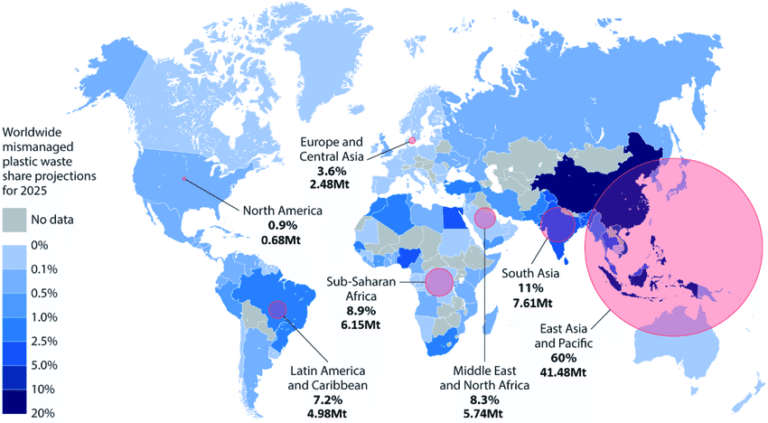
The world stands at a critical juncture in its battle against plastic pollution, with projections for 2025 revealing a deeply troubling pattern: the nations driving global industrial production are simultaneously the worst offenders in plastic waste mismanagement. A comprehensive analysis of worldwide mismanaged plastic waste share projections paints a stark picture of regional disparities, where manufacturing powerhouses bear disproportionate responsibility for environmental degradation compared to their consuming counterparts.
East Asia and Pacific: The Epicenter of Industrial Waste
The East Asia and Pacific region dominates the global landscape of mismanaged plastic waste with a staggering 60% share, translating to approximately 41.48 million metric tons. This region, home to some of the world’s most prolific manufacturing economies, illustrates a fundamental paradox of modern industrialization: nations that produce goods for global consumption struggle most acutely with waste management infrastructure.
China, the manufacturing behemoth that supplies countless products to Western markets, contributes significantly to this figure. The country’s rapid industrialization over the past four decades prioritized production capacity over waste management systems, creating a legacy problem that persists despite recent environmental initiatives. Similarly, Southeast Asian nations like Vietnam, Thailand, and Indonesia have become manufacturing hubs for electronics, textiles, and consumer goods, yet their waste management infrastructure has failed to keep pace with industrial growth.
The irony is profound: these nations manufacture products destined for consumers in developed countries with robust waste management systems, yet the production process itself generates enormous quantities of poorly managed plastic waste. Factory packaging, industrial plastic components, defective products, and manufacturing byproducts accumulate faster than local systems can process them. Meanwhile, the consumer nations that purchase these goods often cite their own relatively lower waste statistics, conveniently overlooking the environmental cost embedded in their consumption patterns.
South Asia: Industrial Growth Outpacing Infrastructure
South Asia accounts for 11% of global mismanaged plastic waste, or 7.61 million metric tons, with the region experiencing explosive industrial expansion. India and Bangladesh have emerged as textile and manufacturing powerhouses, producing garments, electronics, and consumer goods for international markets. Pakistan’s industrial corridors similarly churn out products for export while grappling with inadequate waste management.
The manufacturing facilities dotting these nations operate within economies where infrastructure development lags behind industrial ambition. Chemical plants, plastic manufacturing units, and assembly facilities generate tremendous waste streams, yet municipal systems remain overwhelmed. Urban centers like Delhi, Dhaka, and Karachi showcase this disconnect, where modern factories exist alongside open dumping grounds and polluted waterways choked with industrial plastic waste.
What distinguishes manufacturing nations from consuming nations becomes evident here: the waste isn’t primarily from household consumption but from the production process itself. Raw material packaging, industrial film, protective wrapping, and rejected components create waste at the source, before products even reach end consumers.
Sub-Saharan Africa: The Emerging Manufacturing Challenge
Sub-Saharan Africa’s 8.9% share, equivalent to 6.15 million metric tons, represents both current challenges and future concerns. Nations like Nigeria, Kenya, and Ethiopia are positioning themselves as manufacturing alternatives to Asian economies, attracting factories seeking lower labor costs. However, these countries are repeating historical mistakes, building industrial capacity without corresponding waste management infrastructure.
The continent faces a dual burden: mismanaged waste from emerging domestic manufacturing and plastic waste exported from developed nations seeking disposal solutions. Manufacturing facilities in Lagos, Nairobi, and Addis Ababa contribute to waste streams that local systems cannot adequately handle, while coastal nations also receive shipping containers of “recyclable” plastic from European and North American countries, much of which ends up mismanaged.
Latin America and Caribbean: Industrial Corridors and Coastal Concerns
At 7.2% or 4.98 million metric tons, Latin America demonstrates how manufacturing concentration drives waste mismanagement. Brazil’s industrial heartland, Mexico’s maquiladora zones, and manufacturing centers throughout Colombia and Argentina generate substantial plastic waste. Mexico particularly exemplifies the manufacturing-consumption divide, producing goods primarily for the North American market while struggling with waste management along its industrial corridors.
Coastal manufacturing facilities present additional concerns, with mismanaged plastic waste directly entering ocean ecosystems. The Caribbean islands, though small contributors individually, face mounting pressure from manufacturing waste combined with tourism-related plastic consumption.
Middle East and North Africa: Petrochemical Manufacturing’s Hidden Cost
The Middle East and North Africa region’s 8.3% share (5.74 million metric tons) carries particular significance given the region’s role as a petrochemical manufacturing hub. Nations like Saudi Arabia, UAE, and Egypt don’t just produce finished goods; they manufacture the raw plastic materials that fuel global production chains.
Petrochemical facilities, plastic resin production plants, and polymer manufacturing operations generate waste that differs from consumer plastic but contributes significantly to mismanagement statistics. Industrial zones in these nations prioritize production efficiency over environmental safeguards, and the arid climate complicates waste decomposition and management.
Europe, Central Asia, and North America: The Consumption-Production Paradox
The stark contrast becomes most apparent when examining developed regions. Europe and Central Asia account for merely 3.6% (2.48 million metric tons), while North America contributes just 0.9% (0.68 million metric tons). These regions are among the world’s largest consumers of manufactured goods, yet their mismanaged waste percentages remain remarkably low.
This disparity reveals an uncomfortable truth: wealthy consuming nations have effectively exported their environmental burden. By outsourcing manufacturing to Asia, Africa, and Latin America, these nations enjoy the products while avoiding the waste management challenges inherent in production. Their sophisticated waste management systems handle post-consumer waste effectively, but this statistic ignores the production waste generated abroad on their behalf.
Conclusion: Rethinking Responsibility
The 2025 projections demand a fundamental reassessment of how we attribute responsibility for plastic waste. Manufacturing nations bear the immediate burden of mismanagement, but consuming nations drive the demand that necessitates such production. True solutions require acknowledging this interconnected reality, with developed nations investing in waste management infrastructure within their supply chains and manufacturing nations receiving support to build systems matching their industrial capacity. Only through shared responsibility can the global community address this crisis meaningfully.