

Global Unemployment in 2024
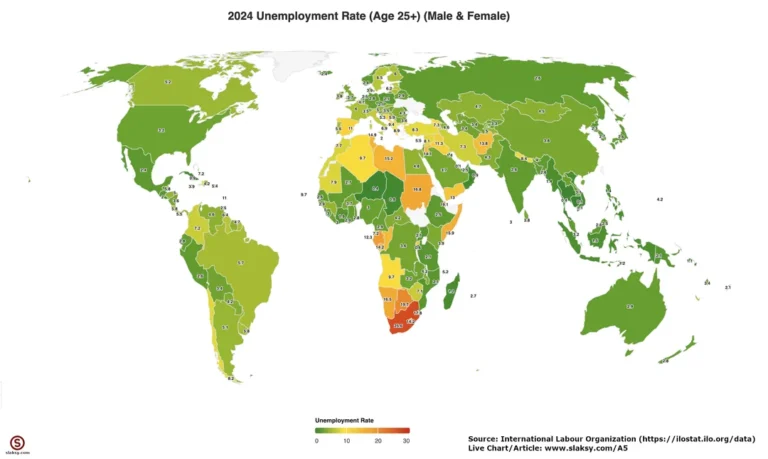
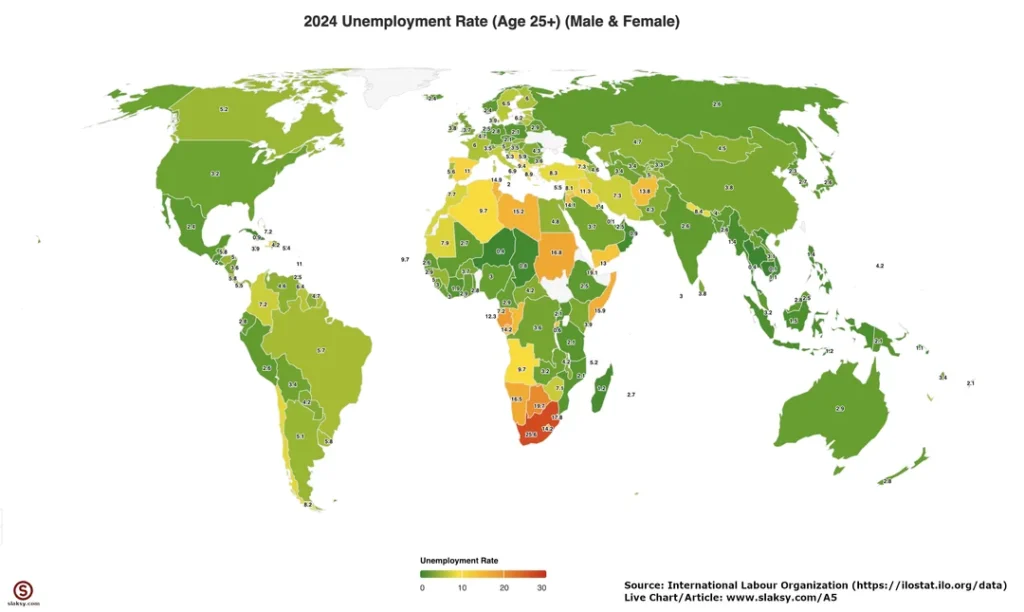
The 2024 world map of unemployment among people aged 25 and above reveals a story that is as much about politics and governance as it is about economics. While some countries enjoy unemployment rates below 4%, others struggle with levels that exceed 25%.
North America: Stability, Skills, and Flexible Labor Markets
North America shows relatively low unemployment, with most areas shaded green.
This reflects several features of the region’s economic and political landscape.Stable democratic institutions that provide predictable rules for investors.Relatively flexible labor markets that make hiring and restructuring easier.Continuous investment in higher education, innovation, and infrastructure.
Where unemployment pockets do appear—for instance in regions dependent on a single declining industry—effective political leadership can soften the blow. Policies that support retraining, mobility, and targeted development incentives help workers transition into new sectors such as technology, renewable energy, and advanced manufacturing. Leaders who recognize these structural shifts early and act decisively keep temporary job losses from becoming long-term unemployment.
South America: The Cost of Volatility and the Promise of Reform
South America is a patchwork of green and yellow, reflecting sharp differences in unemployment performance. Some countries have moderate rates, while others struggle with stubbornly high joblessness.
Several common pressures shape the continent:
Heavy reliance on commodities, which makes economies vulnerable to price swings.Episodes of political upheaval, corruption scandals, and abrupt policy reversals.Persistent inequality that leaves large parts of the population under-skilled and under-employed.
Where leadership has focused on macroeconomic stability, transparent institutions, and social investment, unemployment has declined. Governments that pair sound fiscal policy with long-term infrastructure and education programs tend to attract more diverse investment beyond raw materials. Conversely, when populist measures undermine business confidence or inflation spins out of control, firms delay hiring and unemployment climbs.
Effective leadership here is less about ideology and more about credibility—being able to convince citizens and investors that rules will be consistent, contracts will be honored, and public funds will be used productively rather than politically.
Europe: Balancing Security and Flexibility
Europe’s map is mostly green with pockets of yellow, but the story is nuanced. Many European countries maintain generous welfare systems and strong worker protections, yet still manage reasonably low unemployment. Others, particularly in the south or in post-transition economies, experience higher joblessness.
Key factors shaping European outcomes include, Strong institutions and rule of law that encourage investment and entrepreneurship.High levels of education, vocational training, and apprenticeship programs.Coordinated labor-market policies—such as “flexicurity”—that protect workers while allowing firms to adjust.
Where unemployment remains high, it often reflects structural mismatches: slower growth, rigid labor rules that make hiring risky, or education systems that produce skills misaligned with market needs. The most successful European leaders have been those willing to tackle these structural issues even when reforms are politically sensitive. Modernizing labor codes, digitalizing public services, and supporting innovation ecosystems have helped certain countries shift their maps from yellow toward green over the past decade.
Leadership in Europe also matters in managing demographic change. Aging populations can strain budgets and shrink the labor force. Pro-active policies—encouraging higher labor participation among women and older workers, integrating migrants into the workforce, and promoting lifelong learning—make the difference between a gentle adjustment and a long-term employment crisis.
Africa: The Urgent Challenge of Jobs for a Young Population
Africa stands out on the map with the widest range of colors—from green in a few countries to deep red in others, particularly in the south. Many African nations confront a “jobs emergency”: a rapidly growing young population entering labor markets that are not generating enough formal employment.
The drivers of high unemployment here are complex:Historic underinvestment in education, infrastructure, and industrial capacity.Heavy dependence on extractive industries with limited job creation.Political instability, conflict, and governance challenges in some regions.
Yet the continent’s potential is enormous. Where political leaders prioritize economic diversification, regional trade, and basic infrastructure, unemployment has begun to fall. Investment in power grids, transport corridors, and digital connectivity lowers business costs and invites manufacturing and service industries to expand. Reforming regulations that stifle small businesses—cutting red tape, improving access to credit, and simplifying tax systems—can unlock millions of jobs in the formal and informal sectors alike.
The map’s deep red in some southern countries is a warning sign of what happens when growth remains too narrow and policies fail to integrate young people into the economy. In such contexts, visionary leadership is not a luxury but a necessity. Leaders who build strong institutions, protect property rights, fight corruption, and channel resource revenues into education and infrastructure can gradually shift their nations from red to yellow and then green.
Asia: Diversity of Outcomes and the Power of Strategy
Asia’s unemployment landscape is diverse: several large economies show low to moderate unemployment, while a few countries and regions face higher rates. Overall, much of Asia appears green, reflecting decades of rapid growth and structural transformation.
Several themes explain this pattern.
Strategic industrial policies that nurtured export-led manufacturing and, more recently, digital services.Strong emphasis on education, from basic literacy to engineering and technical skills.Long-term planning cultures in which governments roll out multi-decade development strategies.
Where unemployment is higher, the causes often include conflict, political uncertainty, or a lack of diversification away from agriculture and low-productivity activities. Robust leadership can tackle these obstacles by Creating special economic zones that attract investment and build industrial clusters.Reforming labor regulations to protect workers without choking off formal hiring.Supporting small and medium enterprises with access to finance, technology, and markets.
Asia’s experience shows how deliberate, consistent policy over decades can reshape an economy’s position on the global unemployment map. Countries that combine openness to trade with investments in human capital tend to enjoy sustained job creation.
Oceania: High-Income Economies and the Role of Social Policy
Oceania, dominated by high-income economies, appears predominantly green on the unemployment map. These countries benefit from.
Strong, transparent institutions and predictable legal systems.Well-developed education and health systems that raise productivity.Active labor-market programs, including retraining and job-matching services.
Even in relatively prosperous economies, sectors such as tourism, agriculture, and mining remain exposed to global shocks and climate risks. Here, political leadership focuses on resilience—diversifying economic bases, investing in green technologies, and supporting workers through transitions. Maintaining low unemployment is not automatic; it requires ongoing policy attention to innovation, migration, and inclusion of remote and Indigenous communities in the labor market.
How Political Leadership Lowers Unemployment
Across all continents, several common elements of effective political leadership emerge from the map.
Macroeconomic stability
Low and predictable inflation, responsible public finances, and stable currencies give businesses the confidence to invest and hire. Leaders who resist short-term populist spending in favor of sustainable budgets often secure lower unemployment over time.
Rule of law and institutions
Clear property rights, independent courts, and effective public administration reduce risk and corruption. Investors are more likely to establish factories and offices where contracts are honored and regulations are applied fairly.
Investment in people
Education, vocational training, and health are the foundation of employability. When governments align curricula with industry needs and support lifelong learning, workers can adapt to technological change rather than be displaced by it.
Infrastructure and connectivity
Roads, ports, electricity, and broadband are not luxuries; they are job-creation tools. Political leaders who push through complex, long-horizon infrastructure projects lay the groundwork for private-sector employment.
Inclusive growth and social dialogue
Policies that widen opportunities—supporting women, youth, and marginalized groups—expand the labor force and reduce social tensions. Constructive dialogue among government, employers, and unions helps craft reforms that protect people without freezing labor markets.
Vision and consistency
Perhaps most important, effective leaders articulate a clear economic vision and stick to it across election cycles. Sudden policy reversals, nationalizations, or arbitrary regulations show up quickly on the unemployment map as hiring stalls and investment dries up.