


GENDER EQUALITY WORLD MAP
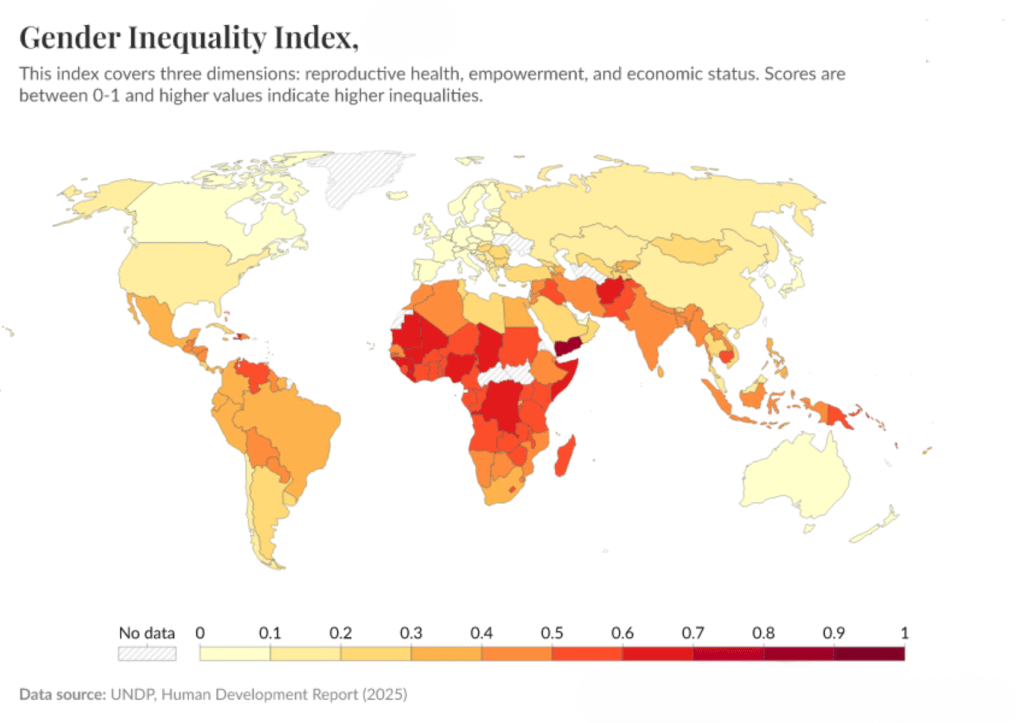
The Gender Inequality Index (GII) map for 2023 visually compares countries by gender disparities in reproductive health, empowerment, and economic status. Scores range from 0 to 1, revealing stark contrasts between regions.
Below is a continent-wise summary, with particular attention to countries lagging behind due to economic, educational, and religious factors.
Africa
Africa shows the world’s highest concentration of gender inequality. Most of Sub-Saharan Africa, including countries like Chad, Niger, Mali, Sudan, the Democratic Republic of the Congo, and Somalia, are marked in deep orange and red, indicating GII values above 0.5. These nations often suffer from entrenched poverty, low educational attainment—especially among girls—and high rates of maternal mortality. Early marriage is prevalent, with restrictive gender norms reinforced by both traditional practices and certain religious interpretations. Many of these countries also have limited access to reproductive health services and face barriers to women’s participation in the workforce and politics. North African countries like Egypt and Algeria fare somewhat better but still show moderate inequality due to persistent gaps in education and limited female economic and political involvement.
Asia
The Middle East and South Asia display considerable gender gaps. Countries like Afghanistan, Pakistan, Yemen, and Iraq feature high inequality (GII > 0.5), often resulting from strict social and religious norms that restrict women’s freedoms, limited educational access for girls, and minimal economic empowerment. Afghanistan exemplifies the impact of political turmoil and conservative religious policies on women’s rights: female literacy and labor force participation are among the lowest globally, and access to reproductive health is severely restricted.
South Asian nations such as India and Bangladesh have moderate GII scores, reflecting advancements in women’s education and health but continued challenges in areas like child marriage, gender-based violence, and economic opportunities.
Southeast Asia generally performs better, as seen in countries like Vietnam, Thailand, and Indonesia, with more progressive education policies and growing female participation in the workforce. However, rural areas and ethnic minorities still face obstacles rooted in conservative religious and traditional norms.
East Asia, including China, Japan, and South Korea, scores among the lowest in inequality. These countries benefit from developed economies, robust public education, and better access to reproductive health, though challenges persist in corporate leadership and cultural expectations around gender roles.
Europe
Europe leads globally in minimizing gender inequality, with most nations—Scandinavia, Western, Central, and Eastern Europe—scoring below 0.2. Sweden, Norway, Denmark, and Finland consistently rank at the top, driven by egalitarian policies, comprehensive public education for both genders, widespread use of reproductive health services, and significant female representation in politics and business. Eastern and Southern Europe, including countries like Romania, Bulgaria, and Greece, show some increased inequality, often due to less robust social safety nets, lower female labor participation, and lingering patriarchal traditions.
Religious factors play less of a restrictive role compared to other regions, but in Balkan countries conservative norms may still impede gender equality, particularly affecting education and empowerment measures.
North America
North America, represented by the United States and Canada, shows low inequality. Both countries have strong economies and established public education systems that help elevate women’s socioeconomic status, although disparities remain—especially for marginalized and indigenous groups. The United States, while generally progressive, experiences disparities in reproductive rights and access to healthcare that can influence GII scores in specific states.
Central America exhibits moderate inequality, with countries like Honduras, Guatemala, and Nicaragua facing challenges from poverty, limited educational resources, and conservative gender norms rooted in both tradition and religion. These issues heighten rates of adolescent pregnancy and reduce women’s participation in economic and political life.
South America
South America is marked largely by moderate inequality. Brazil, Peru, Bolivia, and Paraguay demonstrate significant gender gaps driven by poverty, limited access to quality education, and cultural norms, often underpinned by Catholic tradition. In rural and indigenous communities, girls have less access to secondary and tertiary education, and early marriages remain common. Female empowerment is hampered by underrepresentation in politics and traditional gender roles. Argentina, Uruguay, and Chile display lower inequality, benefiting from stronger economies, progressive policies, and greater female participation in public life.
Oceania
Oceania presents a mixed picture. Australia and New Zealand show low gender inequality, thanks to high living standards, well-developed education systems, and progressive gender policies. The island nations of the Pacific—such as Papua New Guinea and the Solomon Islands—reflect higher GII scores, linked to poverty, underdeveloped infrastructure, limited education for women and girls, and entrenched patriarchal customs. Religion and tradition play a significant role in maintaining these disparities, often restricting women’s access to economic and political opportunities.
Conclusion
The map clearly reflects how economic shortfalls, inadequate education—especially for girls—and religious conservatism combine to perpetuate gender inequality, most starkly across Sub-Saharan Africa, parts of the Middle East and South Asia, and impoverished regions of Latin America and Oceania. Where economic development, educational access, and progressive policies converge, gender disparities shrink substantially.