
INTERNET CENSORSHIP AND FREEDOM OF SPEECH MAP
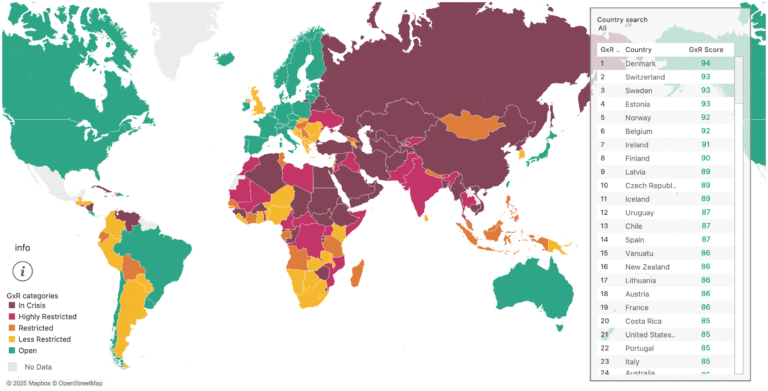
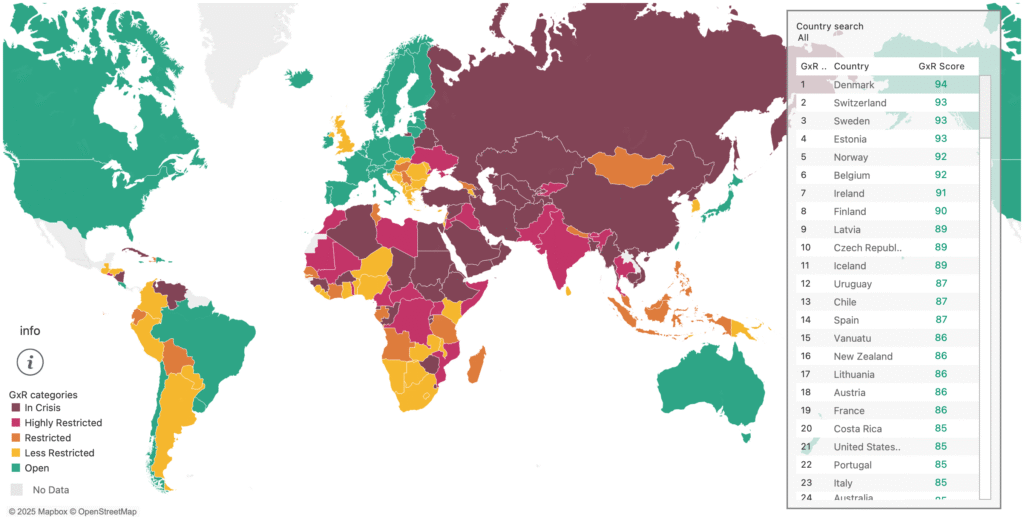
The map shows us the current situation about freedom of speech globally, using color codes to indicate the amount of restriction: dark green for “open,” light green for “less restricted,” yellow for “restricted,” pink for “highly restricted,” and maroon for “in crisis.”
Here’s a concise continent-by-continent summary and discussion of regime types and freedom of speech.
Africa
Most African countries fall into the “highly restricted” and “in crisis” categories, especially in the Central Africa, and in Horn of Africa. Some North African and West African nations are marked as “restricted” , with only a few like South Africa and Namibia are listed as “open.” Many African countries are either authoritarian or have less stable electoral democracies, with numerous state interventions, censorship, or government influence on media and civil society. These types of factors absolutely affects the current state of freedom of speech in African continent.
Asia
Asia shows a dominance of “highly restricted” and “in crisis” classifications, particularly across the Middle East, Central Asia, China, and Russia, with a few exceptions like Japan, South Korea, Taiwan, and Mongolia that are “open.” Most of the “restricted” or worse countries are either single-party states, authoritarian, or theocracies, where state power is concentrated in non-democratic institutions. Socialist one-party states like China and North Korea are among the most restrictive countries for freedom of speech. most of the island nations and other nations which became independent from USSR in 1990’s are highly restricted in terms of freedom of speech.
Europe
Europe shows the biggest cluster of “open” nations, especially across Western, Northern, and much of Central Europe, with Denmark, Switzerland, and Sweden among the highest ranked. Eastern Europe, especially Russia and nearby states, trends toward “in crisis” or “highly restricted,” reflecting autocratic regimes and states where illiberal, nationalist, or pseudo-democratic leadership severely limits and bans dissent and independent journalism in such ways.
North America
The United States and Canada are “open,” reflecting strong legal and cultural protections for speech. However we don’t have the data for Mexico but it still restrict freedom of speech in such way. But other several Central American and Caribbean states fall into “restricted” or “highly restricted” categories, often due to corruption, instability, or semi-authoritarian governance.
South America
South America is mixed: most countries are “open” or “less restricted,” including Uruguay, Chile, Argentina, and Brazil. Venezuela stands out as “in crisis,” demonstrating the collapse of democratic processes under authoritarian socialism, where the government heavily suppresses the press and opposition.
Oceania
Australia and New Zealand are “open,” while other Pacific nations are missing data or in “less restricted” categories.
Conclusion
Authoritarian regimes always, whether socialist or nationalist, generally regard and oppose unfettered free speech as destabilizing. In contrast, consolidated democracies strongly correlate with “open” speech environments, reflecting institutionalized checks on power and protection for minority and dissenting voices. The global map shows these differences starkly, with state structure and ideology being the main drivers of speech freedoms and restrictions.