
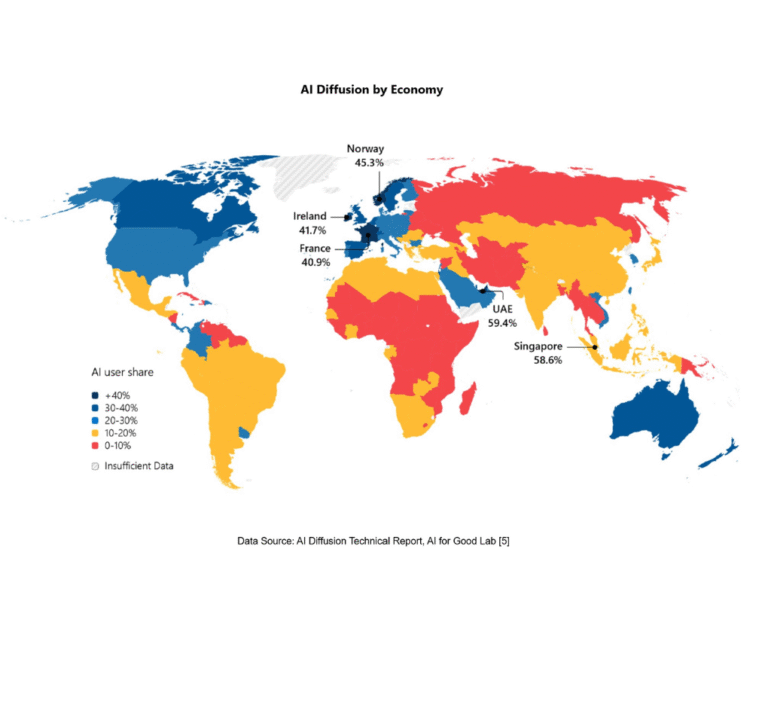


The map shows that AI use is highest in a handful of wealthy, digitally connected economies, while much of Africa, Latin America, and parts of Asia remain in the lowest adoption bands. Education quality, reliable electricity, and affordable internet access are the main factors that explain why AI diffuses quickly in some regions and slowly in others.
What the map measures
The map visualizes “AI user share,” the percentage of working‑age people in each economy who actively use AI tools, based on telemetry from Microsoft services. Countries are colored from dark blue (over 40% of workers using AI) down to red (0–10%), with grey hatching where there is insufficient data.
North America
North America stands out in dark blue, indicating that more than 40% of workers in the United States and Canada use AI tools in some form. This is underpinned by nearly universal electricity, very high broadband and mobile internet penetration, and tertiary education systems that produce abundant digital and AI skills.
Education and digital infrastructure reinforce each other in this region. Universities and community colleges integrate data science, coding, and AI literacy into curricula, while households and schools have reliable power, devices, and connectivity that make everyday AI use routine rather than exceptional. As a result, AI is diffusing not only in tech firms but also across small businesses, healthcare, and government services.
Latin America and the Caribbean
Latin America mostly appears in yellow and orange, with AI user shares typically in the 10–30% range. Electrification is relatively high in many countries, but internet access is uneven, with sharp divides between well‑connected urban centers and underserved rural communities.
Education indicators here are mixed: many countries have made progress in school enrollment, yet learning outcomes and digital skills training often lag behind richer regions. Without strong STEM and AI‑related programs, workers may use basic digital tools but not more advanced AI systems, slowing diffusion beyond early adopters in large corporations and tech hubs.
Europe
Much of Western and Northern Europe appears in dark or medium blue, reflecting AI user shares often above 30%, with leaders such as Norway, Ireland, and France surpassing 40%. These countries combine strong public education systems, high rates of upper‑secondary completion, and well‑funded universities with almost universal access to electricity and fast internet.
In Southern and Eastern Europe, the map shifts more toward yellow and orange, suggesting 10–30% AI user share. Here, gaps often arise from less uniform broadband coverage between urban and rural areas and lower investment in advanced digital skills, even though basic schooling and electrification are relatively strong compared with many other regions.
Asia and the Pacific
Asia shows striking contrasts, from global leaders to large pockets of low diffusion. The United Arab Emirates and Singapore are the two most AI‑intensive economies on the map, with user shares around 59%, reflecting aggressive “smart nation” and digital transformation strategies, heavy investment in AI education and upskilling, and nearly universal high‑speed connectivity. Advanced economies like Japan, South Korea, and Australia also appear in higher adoption bands, supported by excellent schooling, high tertiary enrollment, and robust digital infrastructure.
By contrast, much of South and Southeast Asia shows yellow and red, indicating that fewer than 30% of workers use AI tools. While many countries have rapidly expanding school systems, persistent challenges—overcrowded classrooms, uneven teacher training, unreliable electricity in rural schools, and patchy broadband—limit the ability of students and small firms to experiment with AI. Even where people own smartphones, data costs and unstable connections can keep AI services out of reach or restrict them to narrow use cases.
Africa
Across most of Africa the map is dominated by red and orange, signaling AI user shares below 20% and often below 10%. This pattern aligns with broader development data: many African countries still face significant gaps in electricity access, especially in rural areas, and have some of the lowest internet penetration rates in the world.
Education systems in the region are expanding fast but often struggle with limited resources, teacher shortages, and low completion rates beyond primary school, which constrains the pool of workers with advanced digital skills. Where schools lack computers, stable power, or connectivity, students rarely encounter AI tools in the classroom, and businesses have little incentive or capacity to integrate AI into daily operations. These barriers mean that even when AI platforms exist in global markets, local uptake remains modes
Middle East and North Africa
The region combines standout leaders with lower‑adoption neighbors. The UAE, a dark‑blue outlier at nearly 60% AI user share, benefits from ambitious national AI strategies, massive investment in cloud infrastructure, and extensive digital education and training programs. Other Gulf states with similar levels of electricity and internet coverage are also well‑positioned, even if not all appear in the top band.
In parts of North Africa and the broader Middle East, however, the map shows more yellow and red, reflecting weaker AI diffusion. While basic electrification has improved, many schools still lack computers, connectivity, and up‑to‑date curricula, limiting exposure to AI and higher‑order digital skills. Economic and political instability can further depress both infrastructure investment and long‑term planning for AI in education and public services.
How education, electricity, and internet shape AI use
Across continents, three enablers consistently explain differences in AI diffusion:
- Internet access: High‑speed, low‑cost internet—both fixed and mobile—is the bridge between AI models running in data centers and everyday users. Where broadband coverage is narrow or data is expensive, AI use is concentrated among urban elites and large firms, leaving most of the population outside the “AI diffusion” statistics, even when demand exists.
- Education: Countries that score highest in AI user share also tend to have strong secondary and tertiary education systems, with emphasis on mathematics, science, and digital skills. When teachers and students regularly use digital platforms, AI‑powered tools for learning, assessment, and productivity become a natural extension rather than a radical change.
- Electricity: Reliable, affordable electricity is a prerequisite for any digital technology. In regions where households, schools, and small enterprises experience outages or lack grid connection, computers and servers sit idle, and using cloud‑based AI tools becomes costly or impossible. This is a central constraint in many low‑income African and rural Asian areas, keeping AI user shares in the lowest bands on the map.
The map ultimately tells a story about global inequality as much as about technology. Expanding high‑quality education, universal electricity, and affordable internet—especially in Africa, parts of Asia, and rural Latin America—will be essential to move more countries from red and orange into yellow, blue, and eventually dark blue on future editions of this AI diffusion map.